Requisitos de la Tarjeta Verde en EE. UU.: Lo que necesita saber en 2026
5/12/26
Si está tratando de averiguar cómo obtener una tarjeta verde, contar con la orientación legal adecuada puede marcar la diferencia. Los abogados de tarjetas verdes en Austin de Nanthaveth & Associates han ayudado a cientos de personas y familias a obtener la residencia permanente legal, y conocemos el proceso a la perfección.
Esta guía cubre todo lo que necesita saber sobre cómo obtener una tarjeta verde, desde la elegibilidad inicial hasta la decisión final.
¿Qué es una Tarjeta Verde?
Para millones de personas en Estados Unidos, el estatus de "residente permanente legal" (LPR) abre muchas oportunidades y beneficios. Una tarjeta verde, formalmente conocida como Tarjeta de Residente Permanente Legal, otorga a un ciudadano extranjero el derecho a vivir y trabajar en los Estados Unidos de forma permanente y, finalmente, solicitar la ciudadanía naturalizada.
Como titular de una tarjeta verde, puede:
- Patrocinar a ciertos miembros de la familia para su propia visa de inmigrante o tarjeta de residente permanente;
- Acceder a beneficios federales, como préstamos estudiantiles o el Seguro Social;
- Construir una carrera, abrir un negocio e integrarse plenamente en su comunidad;
- Solicitar la ciudadanía estadounidense después de cumplir los requisitos de residencia.
¿Es una tarjeta verde lo mismo que una visa? No. Una visa generalmente permite la entrada temporal para un propósito específico, mientras que una tarjeta verde otorga la residencia permanente y un camino hacia la ciudadanía.
¿Quién puede solicitar una Tarjeta Verde? Entendiendo las Categorías de Elegibilidad.
Antes de poder solicitar una tarjeta verde, debe encajar en una categoría descrita por la Ley de Inmigración y Nacionalidad (INA). USCIS enumera todas las categorías de elegibilidad en su sitio web, y algunas categorías tienen varias subcategorías dentro de ellas. También existen ciertas "barreras de elegibilidad" que pueden descalificar a una persona, independientemente de la categoría en la que se encuentre.
Tarjetas Verdes Basadas en la Familia

Ciertos parientes tanto de ciudadanos estadounidenses como de residentes permanentes legales (LPR) actuales pueden solicitar una tarjeta verde a través de sus conexiones familiares. Estos incluyen "parientes inmediatos": cónyuges, padres e hijos solteros menores de 21 años. También son elegibles dentro de esta categoría los viudos o viudas de ciudadanos estadounidenses y ciertas víctimas de abuso a manos de ciudadanos estadounidenses o LPR (autopeticionarios VAWA).
Es importante tener en cuenta que USCIS asigna ciertas tarjetas verdes basándose en categorías de preferencia familiar. Estas no incluyen cónyuges directos, hijos menores y padres de ciudadanos estadounidenses. Las categorías de preferencia se clasifican desde la primera preferencia (F1) hasta la cuarta preferencia (F4) y se describen específicamente en el sitio web de USCIS.
Los miembros de la familia elegibles incluyen:
- Hijos adultos solteros de ciudadanos estadounidenses (F1);
- Cónyuges e hijos solteros de residentes permanentes legales (F2A/F2B);
- Hijos casados de ciudadanos estadounidenses (F3);
- Hermanos de ciudadanos estadounidenses adultos (F4).
Estas categorías de preferencia están sujetas a límites anuales de visas y pueden implicar retrasos significativos. Actualmente, la categoría de hermanos (F4) tiene uno de los tiempos de espera más largos en todo el proceso de la tarjeta verde (a menudo más de una década), seguida por los hijos e hijas casados de ciudadanos estadounidenses (F3).
Tarjetas Verdes Basadas en el Empleo
Una tarjeta verde por empleo está disponible para ciertos grupos de profesionales extranjeros. Una tarjeta verde no es lo mismo que una visa H-1B, que es una visa de no inmigrante o temporal que permite a trabajadores internacionales especializados y educados acceder al mercado laboral de EE. UU.
Las tarjetas verdes basadas en el empleo se clasifican por categoría de preferencia:
- EB-1: Trabajadores con habilidades extraordinarias, profesores e investigadores destacados y ejecutivos multinacionales.
- EB-2: Profesionales con títulos avanzados, aquellos con habilidades excepcionales y exención por interés nacional (NIW) solicitantes que pueden autopeticionarse sin el patrocinio de un empleador.
- EB-3: Trabajadores calificados, profesionales con título universitario y trabajadores no calificados.
- EB-5: Inversores que comprometen al menos 1.05 millones de dólares en una nueva empresa que creará puestos de tiempo completo para al menos 10 trabajadores estadounidenses calificados.
Si bien otros ciudadanos extranjeros con habilidades y fortalezas específicas pueden postularse con la elegibilidad y los patrocinadores adecuados, probablemente caerían en categorías de preferencia más bajas. La mayoría de las categorías basadas en el empleo también requieren que el empleador complete la Certificación Laboral PERM antes de presentar la solicitud.
#cta_start
¿No está seguro si califica?
Descúbralo hoy mismo. Una consulta rápida es todo lo que necesita para saber exactamente cuál es su situación y cuáles son sus opciones.
#cta_end
Tarjeta Verde a Través del Estatus de Refugiado o Asilado
Cualquier persona que ya haya recibido el estatus de asilado o refugiado puede solicitar una tarjeta verde. Para recibir cualquiera de los dos estatus, los solicitantes deben participar en un riguroso proceso de solicitud y selección que incluye verificaciones de antecedentes y entrevistas. Cualquier solicitante de tarjeta verde dentro de esta categoría debe haber tenido su estatus asignado durante al menos un año al momento de la presentación.
Lotería de Visas de Diversidad
El Programa de Visas de Inmigrante por Diversidad, más comúnmente llamado la "lotería de la tarjeta verde", fue diseñado para ofrecer aproximadamente 50,000 visas de inmigrante por año a solicitantes de países con una inmigración históricamente baja a EE. UU.
Sin embargo, a finales de 2025, el programa fue suspendido por acción ejecutiva y actualmente no se están emitiendo nuevas visas. La suspensión no significa que el programa haya sido eliminado permanentemente, pero los solicitantes no deberían contar con él como una vía confiable en este momento. Consulte Travel.State.Gov para conocer el estado más actual.
Categorías Humanitarias y Otras
Existen varias categorías adicionales de tarjetas verdes para circunstancias específicas, como:
- Víctimas de trata de personas que poseen una visa de no inmigrante T;
- Víctimas de actividad criminal que poseen una visa de no inmigrante U;
- Jóvenes inmigrantes especiales (SIJ), niños que han sufrido abuso o abandono;
- Ciertos ciudadanos afganos e iraquíes que asistieron a las fuerzas estadounidenses;
- Individuos con presencia continua en EE. UU. desde el 1 de enero de 1972.
Requisitos para Obtener una Tarjeta Verde

Más allá de encajar en una categoría de elegibilidad particular, existen requisitos generales para obtener una tarjeta verde que todos los solicitantes deben cumplir.
Requisitos Generales de Admisibilidad
USCIS puede denegar una solicitud de tarjeta verde si se considera que el solicitante es inadmisible. Según el Manual de Políticas, los motivos comunes de inadmisibilidad incluyen:
- Ciertas condenas penales, tanto dentro como fuera de EE. UU.;
- Violaciones migratorias previas, como exceder el tiempo de una visa por más de seis meses;
- Vínculos con el terrorismo o intentos de subvertir al gobierno de EE. UU.;
- Ser considerado propenso a convertirse en carga pública;
- Ciertas condiciones de salud o un historial de vacunación incompleto.
Si tiene factores en su historial que podrían afectar su elegibilidad, es esencial hablar con un abogado de inmigración antes de presentar la solicitud. Podrían haber exenciones disponibles en algunos casos.
Requisitos de Patrocinio y Financieros
Muchos solicitantes de tarjeta verde necesitan un patrocinador (un ciudadano estadounidense o un familiar residente permanente legal, o un empleador estadounidense) para presentar una petición de inmigrante en su nombre.
Para casos basados en la familia, el patrocinador debe presentar una Declaración Jurada de Patrocinio Económico aceptando formalmente la responsabilidad financiera por el solicitante. USCIS requiere que el patrocinador cumpla o supere las pautas nacionales de pobreza según el tamaño de su hogar y está examinando cada vez más los casos en los que el patrocinador apenas supera ese umbral.
Es importante asegurarse de que las finanzas de su peticionario cumplan o superen significativamente el nivel requerido, o identificar un copatrocinador que lo haga.
El Proceso de Solicitud de la Tarjeta Verde

Cada caso de tarjeta verde sigue el mismo procedimiento general, independientemente de la categoría. Esto es lo que puede esperar.
Paso 1: Presentar la Petición de Inmigrante
El proceso comienza con una petición de inmigrante, no con la solicitud de tarjeta verde en sí. Existen varios formularios diferentes para este propósito:
- Casos basados en la familia: Su familiar ciudadano estadounidense o residente permanente debe presentar el Form I-130, Petición para Familiar Extranjero.
- Casos VAWA (Ley de Violencia contra la Mujer): Puede autopeticionarse utilizando el Form I-360, Petición para Amerasiático, Viudo(a) o Inmigrante Especial.
Una vez que USCIS reciba la petición, recibirá un aviso de recibo y, finalmente, un aviso de aprobación. Esto no significa que su tarjeta verde haya sido aprobada. Solo significa que la agencia ha aceptado la petición.
Paso 2: Espere un número de visa (si es necesario)
Los familiares inmediatos de ciudadanos estadounidenses (cónyuges, padres e hijos solteros menores de 21 años) omiten este paso porque siempre hay un número de visa disponible para ellos. Todos los demás deben esperar a que un número esté disponible antes de que se pueda presentar su solicitud de tarjeta verde.
El Boletín de Visas, publicado mensualmente por el Departamento de Estado de EE. UU., rastrea las fechas de prioridad por categoría y país de nacimiento. Algunas categorías, como la de hermanos de ciudadanos estadounidenses, pueden implicar tiempos de espera de años o incluso décadas.
Paso 3: Solicite su Tarjeta Verde
Una vez que un número de visa esté disponible, presentará la solicitud de tarjeta verde.
Si se encuentra dentro de EE. UU., puede ser elegible para ajustar su estatus presentando el Formulario I-485. La mayoría de los solicitantes presentan el Formulario I-765 (autorización de empleo) y el Formulario I-131 (documento de viaje) al mismo tiempo para poder trabajar y viajar mientras su caso está pendiente.
Si se encuentra fuera de EE. UU., su caso pasará por un procesamiento consular en una Embajada de EE. UU. en el extranjero, coordinado a través del Centro Nacional de Visas.
Documentos de Apoyo para su Solicitud de Tarjeta Verde

Deberá proporcionar documentación de apoyo al solicitar una tarjeta verde. Además de sus fotos tipo pasaporte, identificación emitida por el gobierno, certificado de nacimiento y documentos de admisión inicial, es posible que también deba proporcionar documentos para sus familiares inmediatos. Otros documentos que podría necesitar incluir son:
- Antecedentes policiales certificados
- Su certificado o licencia de matrimonio
- Registros de divorcio
- Prueba de que ha mantenido un estatus legal desde su llegada a EE. UU.
- Registros de adopción
- Prueba de empleo
- Exenciones, si le fueron concedidas
- Documentos de apoyo financiero, incluyendo las declaraciones de impuestos y recibos de nómina de su patrocinador
- Resultados del examen médico de un cirujano civil aprobado por USCIS
Una de las cosas más críticas en las que centrarse es proporcionar pruebas sólidas de la relación, tanto para casos de cónyuges como de padres e hijos. Los funcionarios de USCIS examinarán cuidadosamente si la relación es genuina y querrán ver que están activamente involucrados en la vida del otro. Evidencia como fotos, mensajes, registros financieros compartidos e historial de viajes pueden ser útiles para este propósito.
Después de Solicitar: Datos Biométricos, Examen Médico y Entrevista
Si está solicitando un ajuste de estatus dentro de EE. UU. utilizando el Formulario I-485, hay algunos pasos adicionales que deberá completar antes de que USCIS pueda tomar una decisión. Tenga en cuenta que los solicitantes que pasan por el procesamiento consular en el extranjero siguen un procedimiento ligeramente diferente coordinado a través del Centro Nacional de Visas.
Examen Médico
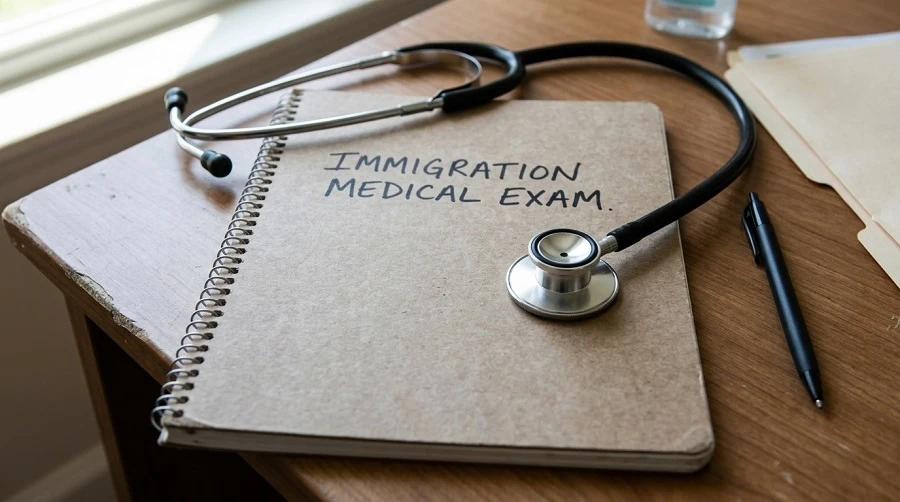
Antes de presentar su I-485, debe someterse a un examen médico con un cirujano civil designado por USCIS utilizando el Formulario I-693, que verifica enfermedades transmisibles y confirma que todas las vacunas requeridas están al día. Consulte nuestra guía de examen médico de USCIS para un desglose completo.
Cita de Datos Biométricos
Después de presentar su solicitud, USCIS programará una cita de datos biométricos, donde proporcionará huellas dactilares, una foto y una firma para una verificación de antecedentes. Este proceso dura aproximadamente 15 minutos.
La Entrevista de Tarjeta Verde de USCIS
Casi todas las personas deben pasar por una entrevista de inmigración con un oficial de inmigración de USCIS al solicitar una tarjeta verde. Estas entrevistas suelen terminar en menos de media hora, pero no siempre.
Puede esperar que el funcionario de USCIS asignado a su caso le haga preguntas sobre su solicitud, sus antecedentes y si algo ha sucedido en su vida que podría afectar su solicitud, como un arresto, el nacimiento de un hijo o un nuevo trabajo. Para los casos basados en matrimonio, espere preguntas como:
- ¿Cómo, cuándo y dónde conoció a su cónyuge?
- ¿Cuál es la fecha de nacimiento de su cónyuge?
- ¿Cómo es el horario de trabajo de su cónyuge?
- ¿Comparten dinero?
- ¿Cuándo decidieron casarse? ¿Cómo le propuso matrimonio su cónyuge (o cómo le propuso matrimonio usted a su cónyuge)?
- ¿Puede describir los muebles de su dormitorio?
Es posible que reciba una decisión en su entrevista. Sin embargo, a veces los funcionarios de inmigración necesitan más información para tomar una decisión, y si eso sucede, tendrá que esperar.
#cta_start
¿Listo para presentar su solicitud? Empecemos.
Cuando trabaja con Nanthaveth & Associates, nuestro equipo capacitado se encargará de cada paso, desde la recopilación de documentos hasta la preparación para la entrevista de USCIS. Siempre sabrá el estado de su caso.
#cta_end
¿Cuánto Tiempo Tarda en Obtenerse una Tarjeta Verde?
El tiempo que se tarda en obtener una tarjeta verde depende principalmente de su categoría y país de nacimiento. Las cosas avanzan más rápido para los familiares inmediatos de ciudadanos estadounidenses, ya que no hay un límite anual para este grupo. Estos casos suelen resolverse en un plazo de 12 a 18 meses desde la presentación.
Las categorías de preferencia familiar son otra historia. El plazo para la categoría de hermanos (F4) puede extenderse por décadas, y los hijos e hijas casados de ciudadanos estadounidenses (F3) no se quedan atrás. Los solicitantes basados en empleo nacidos en India o China enfrentan esperas adicionales debido a los límites anuales por país.
Si bien la categoría bajo la cual califica determina en gran medida su plazo, hay cosas que puede hacer para evitar alargar innecesariamente la duración del proceso:
- Presente una solicitud completa y sin errores. Cualquier error en el formulario o documento faltante podría desencadenar una Solicitud de Evidencia (RFE) y añadir meses a su caso.
- Asegúrese de que los ingresos de su patrocinador superen claramente el umbral de la guía de pobreza, o consiga un patrocinador conjunto con anticipación.
- Pregunte a su abogado si el procesamiento prioritario está disponible para su tipo de petición, ya que puede reducir significativamente el tiempo de revisión de USCIS para ciertas categorías basadas en empleo.
Lo más importante es trabajar con un abogado de inmigración experimentado desde el inicio de su caso. Ellos pueden recopilar y revisar todos los formularios y pruebas, prepararlo para su entrevista y detectar problemas antes de que lo haga USCIS.
Titulares de Tarjeta Verde: Derechos y Responsabilidades

Una vez que tenga su tarjeta verde, preservar su estatus de residente permanente requiere atención continua.
En primer lugar, debe evitar ausencias prolongadas de EE. UU. Permanecer fuera del país por más de seis meses puede generar preguntas sobre su intención de mantener la residencia, y las ausencias de más de un año pueden resultar en el abandono de estatus.
Las tarjetas verdes deben renovarse cada 10 años utilizando el Formulario I-90. Si es necesario un viaje prolongado, un permiso de reingreso puede proteger su estatus por hasta dos años.
La posesión de una tarjeta verde también conlleva obligaciones fiscales en EE. UU. Como residente permanente legal, generalmente se le exige presentar declaraciones de impuestos federales de EE. UU. sobre sus ingresos mundiales. Se recomienda encarecidamente consultar a un profesional fiscal calificado cuando reciba su tarjeta verde.
Después de cinco años como residente permanente (o tres años si obtuvo su tarjeta a través del matrimonio con un ciudadano estadounidense), puede ser elegible para solicitar la ciudadanía naturalizada.
Trabaje con un Abogado de Tarjeta Verde Experto en Austin
Un solo error en un formulario, un documento omitido o un plazo incumplido podría costarle meses de arduo trabajo y espera.
Los compasivos abogados de inmigración de Nanthaveth & Associates han manejado innumerables tarjetas verdes basadas en la familia, peticiones basadas en el empleo, casos de ajuste de estatus y mucho más para clientes en Austin y en todo Texas. Programe una consulta hoy mismo y obtenga ayuda para dar el siguiente paso hacia la residencia permanente.
Preguntas Frecuentes
¿Qué es un residente permanente legal?
Un residente permanente legal es un ciudadano extranjero que ha sido autorizado para vivir y trabajar en los Estados Unidos de forma indefinida. La Tarjeta de Residente Permanente, o tarjeta verde, es el documento que prueba este estatus.
¿Cuál es la forma más fácil de obtener una tarjeta verde?
No existe un camino único "más fácil", ya que su elegibilidad depende completamente de sus circunstancias. Dicho esto, los familiares inmediatos de ciudadanos estadounidenses —cónyuges, hijos solteros menores de 21 años y padres— avanzan en el proceso más rápido porque su categoría no tiene un límite anual de visas.
¿Cuánto cuesta una solicitud de tarjeta verde?
Las tarifas de presentación gubernamentales varían según la categoría y el método de presentación. Para el ajuste de estatus dentro de EE. UU., las tarifas totales pueden superar los $2,000 e incluyen la solicitud I-485, datos biométricos, autorización de empleo y documento de viaje. Los solicitantes también deben pagar por separado un examen médico. Siempre consulte la tabla de tarifas de USCIS para conocer los montos actuales, ya que las tarifas se actualizan periódicamente.
¿Puedo trabajar mientras se procesa mi solicitud de tarjeta verde?
La mayoría de los solicitantes que presentan el Formulario I-485 pueden presentar simultáneamente el Formulario I-765 para recibir un Documento de Autorización de Empleo (EAD) que les permite trabajar legalmente mientras USCIS procesa su caso.
¿Qué es una tarjeta verde condicional?
Si su tarjeta verde se basa en un matrimonio que tenía menos de dos años en el momento en que se le otorgó la tarjeta, recibirá una tarjeta condicional de dos años. Debe presentar el Formulario I-751 antes de que esta tarjeta expire para recibir una tarjeta de residente permanente estándar de 10 años.
Comparta esta página



Programar una consulta
O llámenos
Inicie su Solicitud de Tarjeta Verde Ahora
Nuestro equipo gestionará toda la documentación necesaria, le preparará para la entrevista del USCIS y hará avanzar su caso de principio a fin. Usted podrá centrarse en su vida mientras nosotros gestionamos el proceso legal.
Programar una consulta
O llámanos
Publicaciones similares

Libertad condicional en vigor
12/23/2025
Todo sobre las visas H-2B
12/23/2025