Green Card Requirements in the U.S.A.: What You Need to Know in 2026
5/12/26
If you're trying to figure out how to get a green card, having the right legal guidance can make all the difference. The Austin green card lawyers at Nanthaveth & Associates have helped hundreds of individuals and families obtain lawful permanent residence, and we know the process inside and out.
This guide covers everything you need to know about how to obtain a green card, from initial eligibility to the final decision.
What Is a Green Card?
For millions of people in America, "lawful permanent resident" (LPR) status unlocks many opportunities and benefits. A green card, formally known as a Legal Permanent Resident Card, gives a foreign national the right to live and work in the United States on a permanent basis, and eventually petition to become a naturalized citizen.
As a green card holder, you can:
- Sponsor certain family members for their own immigrant visa or permanent resident card;
- Access federal benefits, such as student loans or Social Security;
- Build a career, open a business, and integrate fully into your community;
- Apply for U.S. citizenship after meeting the residency requirements.
Is a green card the same as a visa? No. A visa typically allows temporary entry for a specific purpose, while a green card grants permanent residence and a pathway to citizenship.
Who Can Apply for a Green Card? Understanding the Eligibility Categories.
Before you can apply for a green card, you must fit into a category outlined by the Immigration and Nationality Act (INA). USCIS lists all eligibility categories on its website, and some categories have several sub-categories within them. There are also certain "bars to eligibility" that can disqualify a person regardless of which category they fall under.
Family-Based Green Cards

Certain relatives of both U.S. citizens and current lawful permanent residents (LPRs) can apply for a green card through their familial connections. These include "immediate relatives" — spouses, parents, and unmarried children under 21 years of age. Also eligible within this category are widows or widowers of U.S. citizens and certain victims of abuse at the hands of U.S. citizens or LPRs (VAWA self-petitioners).
It's important to note that the USCIS allocates certain green cards based on family preference categories. These do not include direct spouses, minor children, and parents of U.S. citizens. Preference categories rank from first preference (F1) to fourth preference (F4) and are specifically described on the USCIS website.
Eligible family members include:
- Unmarried adult children of U.S. citizens (F1);
- Spouses and unmarried children of lawful permanent residents (F2A/F2B);
- Married children of U.S. citizens (F3);
- Siblings of adult U.S. citizens (F4).
These preference categories are subject to annual visa caps and can involve significant backlogs. Currently, the sibling category (F4) has one of the longest wait times in the entire green card process (often well over a decade), followed by married sons and daughters of U.S. citizens (F3).
Employment-Based Green Cards
A green card through employment is available to certain groups of foreign professionals. A green card is not the same as an H-1B visa, which is a non-immigrant or temporary visa allowing specialized and educated international workers access to the U.S. job market.
Employment-based green cards are ranked by preference category:
- EB-1: Workers with extraordinary ability, outstanding professors and researchers, and multinational executives.
- EB-2: Professionals with advanced degrees, those with exceptional ability, and national interest waiver (NIW) applicants who can self-petition without employer sponsorship.
- EB-3: Skilled workers, professionals with a bachelor's degree, and unskilled workers.
- EB-5: Investors who commit at least $1.05 million to a new enterprise that will create full-time positions for at least 10 qualifying U.S. workers.
While other foreign nationals with specific skills and strengths may apply with the appropriate eligibility and sponsors, they would likely fall under lower preference categories. Most employment-based categories also require the employer to complete PERM Labor Certification before filing.
#cta_start
Not Sure If You Qualify?
Find out today. A quick consultation is all it takes to know exactly where you stand and what your options are.
#cta_end
Green Card Through Refugee or Asylee Status
Any person who has already received either asylee or refugee status can apply for a green card. In order to receive either status, applicants must participate in a rigorous application and screening process involving background checks and interviews. Any green card applicant within this category must have had their assigned status for at least one year at the time of submission.
Diversity Visa Lottery
The Diversity Immigrant Visa Program, more commonly called the “green card lottery,” was designed to offer approximately 50,000 immigrant visas per year to applicants from countries with historically low immigration to the U.S.
However, in late 2025, the program was suspended by executive action, and no new visas are currently being issued. The suspension doesn’t mean the program has been permanently eliminated, but applicants shouldn’t count on it as a reliable pathway at this time. Check Travel.State.Gov for the most current status.
Humanitarian and Other Categories
There are several additional green card categories for specific circumstances, such as:
- Human trafficking victims who hold a T nonimmigrant visa;
- Victims of criminal activity who hold a U nonimmigrant visa;
- Special immigrant juveniles (SIJs), children who have suffered abuse or abandonment;
- Certain Afghan and Iraqi nationals who assisted U.S. forces;
- Individuals with continuous U.S. presence since January 1, 1972.
Requirements for Obtaining a Green Card

Beyond fitting into a particular eligibility category, there are general requirements for obtaining a green card that all applicants must meet.
General Admissibility Requirements
USCIS can deny a green card application if the applicant is deemed inadmissible. According to the agency’s Policy Manual, common grounds for inadmissibility include:
- Certain criminal convictions, both inside and outside the U.S.;
- Prior immigration violations, such as overstaying a visa for more than six months;
- Ties to terrorism or attempts to subvert the U.S. government;
- Being considered likely to become a public charge;
- Certain health conditions or an incomplete vaccination history.
If you have factors in your record that might affect your eligibility, it’s essential to speak with an immigration attorney before filing. Waivers may be available in some cases.
Sponsorship and Financial Requirements
Many green card applicants need a sponsor (a U.S. citizen or lawful permanent resident family member, or a U.S. employer) to file an immigrant petition on their behalf.
For family-based cases, the sponsor must file an Affidavit of Support formally accepting financial responsibility for the applicant. USCIS requires the sponsor to meet or exceed the national poverty guidelines based on their household size and is increasingly scrutinizing cases where the sponsor only barely clears that threshold.
It's important to make sure your petitioner's finances meet or significantly exceed the required level, or to identify a joint sponsor who does.
The Green Card Application Process

Every green card case follows the same general procedure, regardless of category. Here's what to expect.
Step 1: File the Immigrant Petition
The process starts with an immigrant petition, not the green card application itself. There are several different forms for this purpose:
- Family-based cases: Your U.S. citizen or permanent resident family member must file Form I-130, Petition for Alien Relative.
- VAWA (Violence Against Women Act) cases: You may self-petition using Form I-360, Petition for Amerasian, Widow(er), or Special Immigrant.
Once USCIS receives the petition, you’ll receive a receipt notice and, eventually, an approval notice. This doesn’t mean your green card has been approved. It just means the agency has accepted the petition.
Step 2: Wait for a Visa Number (If Required)
Immediate relatives of U.S. citizens (spouses, parents, and unmarried children under 21) skip this step because a visa number is always available for them. Everyone else must wait for a number to become available before their green card application can be filed.
The Visa Bulletin, published monthly by the U.S. Department of State, tracks priority dates by category and country of birth. Some categories, like siblings of U.S. citizens, can involve wait times of years or even decades.
Step 3: Apply for Your Green Card
Once a visa number is available, you’ll file the actual green card application.
If you're inside the U.S., you may be eligible to adjust your status by filing Form I-485. Most applicants file Form I-765 (employment authorization) and Form I-131 (travel document) at the same time so they can work and travel while their case is pending.
If you're outside the U.S., your case will go through consular processing at a U.S. Embassy abroad, coordinated through the National Visa Center.
Supporting Documents for Your Green Card Application

You'll have to provide some supporting documentation when you apply for a green card. In addition to your passport-style photos, government-issued ID, birth certificate and initial admission documents, you may have to provide documents for your immediate relatives, as well. Some other documents you might need to provide include:
- Certified police records
- Your marriage certificate or license
- Divorce records
- Proof that you've maintained a lawful status since you arrived in the U.S.
- Adoption records
- Proof of employment
- Waivers, if you were granted any
- Financial support documents, including your sponsor's tax returns and pay stubs
- Medical exam results from a USCIS-approved civil surgeon
One of the most critical things to focus on is providing strong proof of relationship, for both spousal and parent-child cases. USCIS officials will look carefully at whether the relationship is genuine and will want to see that you’re actively involved in each other's lives. Evidence like photos, messages, shared financial records, and travel history can all be useful for this purpose.
After You Apply: Biometrics, Medical Exam, and Interview
If you're filing for adjustment of status inside the U.S. using Form I-485, there are a few additional steps you'll need to complete before USCIS can make a decision. Note that applicants going through consular processing abroad follow a slightly different procedure coordinated through the National Visa Center.
Medical Exam
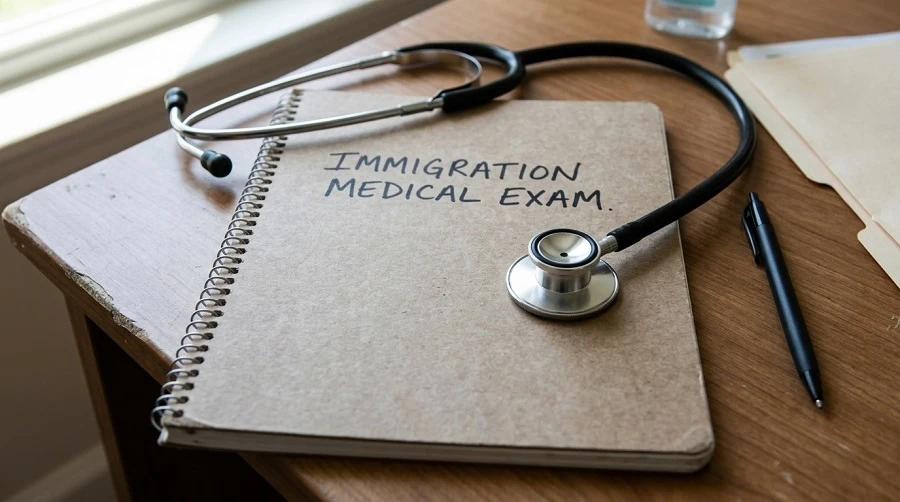
Before filing your I-485, you must undergo a medical exam with a USCIS-designated civil surgeon using Form I-693, which checks for communicable diseases and confirms that all required vaccinations are current. See our USCIS medical exam guide for a full breakdown.
Biometrics Appointment
After filing your application, USCIS will schedule a biometrics appointment, where you’ll provide fingerprints, a photo, and a signature for a background check. This process takes about 15 minutes.
The USCIS Green Card Interview
Almost everyone has to go through an immigration interview with a USCIS immigration officer when they're applying for a green card. These interviews are usually over in less than half an hour, but not always.
You can expect the USCIS official assigned to your case to ask you questions about your application, your background and if anything has happened in your life that could affect your application, like an arrest, the birth of a child, or a new job. For marriage-based cases, expect questions like:
- How, when and where did you meet your spouse?
- What's your spouse's birthday?
- What's your spouse's work schedule like?
- Do you share money?
- When did you decide to marry? How did your spouse propose to you (or how did you propose to your spouse)?
- Can you describe the furniture in your bedroom?
You might receive a decision at your interview. However, sometimes immigration officials need more information to make a decision — and if that happens, you'll have to wait.
#cta_start
Ready to File? Let's Get Started.
When you work with Nanthaveth & Associates, our capable team will handle every step, from gathering documents to preparing you for the USCIS interview. You'll always know where your case stands.
#cta_end
How Long Does It Take to Get a Green Card?
The amount of time it takes to get a green card depends primarily on your category and country of birth. Things move the fastest for immediate relatives of U.S. citizens since there’s no annual cap on this group. These cases typically resolve within 12–18 months of filing.
Family preference categories are a different story. The timeline for the sibling category (F4) can stretch on for decades, and married sons and daughters of U.S. citizens (F3) aren't far behind. Employment-based applicants born in India or China face additional waits on top of that due to per-country annual limits.
While the category you qualify under largely determines your time frame, there are things you can do to avoid adding to the duration of the process unnecessarily:
- File a complete, error-free application. Any form mistakes or missing documents could trigger a Request for Evidence (RFE) and add months to your case.
- Make sure your sponsor's income clearly exceeds the poverty guideline threshold, or line up a joint sponsor early on.
- Ask your attorney whether premium processing is available for your petition type, as it can cut USCIS review time significantly for certain employment-based categories.
Most importantly, work with an experienced immigration attorney from the start of your case. They can compile and review all forms and evidence, prepare you for your interview, and catch issues before USCIS does.
Green Card Holders: Rights and Responsibilities

Once you have your green card, preserving your permanent resident status requires ongoing attention.
First and foremost, you must avoid prolonged absences from the U.S. Remaining outside the country for more than six months can raise questions about your intent to maintain residency, and absences of more than one year can result in abandonment of status.
Green cards must be renewed every 10 years using Form I-90. If extended travel is necessary, a reentry permit can protect your status for up to two years.
Holding a green card also triggers U.S. tax obligations. As a lawful permanent resident, you’re generally required to file U.S. federal tax returns on your worldwide income. Consulting a qualified tax professional when you receive your green card is strongly recommended.
After five years as a permanent resident (or three years if you obtained your card through marriage to a U.S. citizen), you may be eligible to apply for naturalized citizenship.
Work with a Knowledgeable Green Card Lawyer in Austin
A single form error, missed document, or unmet deadline could cost you months of hard work and waiting.
The compassionate immigration attorneys at Nanthaveth & Associates have handled countless family-based green cards, employment-based petitions, adjustment-of-status cases, and much more for clients across Austin and throughout Texas. Schedule a consultation today and get help taking the next step toward permanent residency.
Frequently Asked Questions
What is a lawful permanent resident?
A lawful permanent resident is a foreign national who has been authorized to live and work in the United States indefinitely. The Permanent Resident Card, or green card, is the document that proves this status.
What is the easiest way to get a green card?
There’s no single "easiest" path, as your eligibility depends entirely on your circumstances. That said, immediate relatives of U.S. citizens — spouses, unmarried children under 21, and parents — move through the process the fastest because their category has no annual visa cap.
How much does a green card application cost?
Government filing fees vary by category and method of filing. For adjustment of status inside the U.S., total fees can exceed $2,000 and include the I-485 application, biometrics, employment authorization, and travel document. Applicants must also pay separately for a medical exam. Always check USCIS’s fee schedule for current amounts, as fees are updated periodically.
Can I work while my green card application is processing?
Most applicants who file Form I-485 can simultaneously file Form I-765 to receive an Employment Authorization Document (EAD) that allows them to work legally while USCIS processes their case.
What is a conditional green card?
If your green card is based on a marriage that was less than two years old at the time your card was granted, you’ll receive a two-year conditional card. You must file Form I-751 before this card expires to receive a standard 10-year permanent resident card.
Share This Page



Schedule a Consultation
Or call us
Start Your Green Card Application Now
Our team will handle all necessary paperwork, prepare you for the USCIS interview, and keep your case moving from start to finish. You can focus on your life while we manage the legal process.
Schedule a Consultation
Or call us
Similar Posts

Parole in Place
12/23/2025
All About H-2B Visas
12/23/2025