EB-1A Visa Guide: How to Secure a Green Card for Extraordinary Ability
4/17/26
The U.S. immigration system offers several paths to permanent residency, but few are as prestigious or flexible as the coveted EB-1A visa. Reserved for individuals at the very top of their fields, this category allows world-class professionals and performers with “extraordinary ability” to bypass some of the most frustrating hurdles in the immigration process.
The knowledgeable EB-1 lawyers at Nanthaveth & Associates help scientists, artists, business leaders, and athletes navigate the complex EB-1A eligibility criteria to turn career excellence into a permanent future in the United States.
What Is an EB-1A Visa?
The EB-1A visa is a first-preference, employment-based immigrant category for foreign nationals who can demonstrate extraordinary ability and sustained national or international acclaim in the sciences, arts, education, business, or athletics.
Unlike temporary work visas, the EB-1A classification can lead directly to lawful permanent residence in the U.S. It’s intended for individuals whose achievements place them among the very best in their field.
That doesn’t mean getting approved is easy, however. USCIS applies a high evidentiary standard and looks not only at whether the petitioner meets the basic threshold criteria but also at whether their overall record proves extraordinary ability.
Why the EB-1A Visa Stands Out
The EB-1A category is one of the most flexible employment-based immigration options available to highly accomplished professionals.
Key advantages include:
- Self-petitioning: You may file your own Form I-140 without employer sponsorship.
- No PERM labor certification: You don’t need to complete the labor certification process.
- First-preference category: The EB-1A category may offer faster visa availability than other employment-based categories, depending on the applicant’s country of birth.
- Direct path to permanent residence: The EB-1A is an immigrant petition, not a temporary status.
For qualified applicants, this combination of factors can make pursuing an EB-1A visa one of the strongest long-term immigration strategies there is.
EB-1A Eligibility Criteria: The "Small Percentage" Rule
To qualify for an EB-1A visa, you must show that you’re one of the small percentage who have risen to the top of your field of endeavor.
According to USCIS, this can be proven in one of two ways. The first is a one-time achievement of a major, internationally recognized award, such as a Nobel Prize, Academy Award, or Olympic Medal. The second is meeting at least three of the 10 specific requirements outlined by immigration authorities.
10 Criteria for EB-1A Approval
Most applicants focus on meeting at least three of the following criteria for EB-1A visas:
- Lesser awards: Documentation of nationally or internationally recognized prizes or awards for excellence.
- Membership in formal associations: Membership in industry or field associations that require outstanding achievements of their members.
- Published material: Material about you put out by large trade publications or other major media.
- Judging experience: Evidence that you’ve been invited to judge the work of others individually or as part of a panel.
- Original contributions: Evidence of original scientific, scholarly, artistic, athletic, or business-related contributions of major significance.
- Scholarly articles: Authorship of scholarly articles in professional or large trade publications or other major media.
- Artistic exhibitions: Evidence that your work has been displayed at artistic exhibitions or showcases.
- Leading/critical role: Performance of a leading or critical role in distinguished organizations.
- High salary: Evidence that you command a high salary or other substantial remuneration in relation to others in the field.
- Commercial success: Evidence of commercial successes in the performing arts.
Simply checking the boxes isn't enough — you must provide compelling evidence for each criterion.
Comparable Evidence: What If the Standard Criteria Don’t Fit Your Field?
In some industries, the standard EB-1A criteria may not fully reflect how excellence is recognized. In such instances, USCIS may accept comparable evidence if the usual criteria don’t readily apply. This is often the case in newer industries, specialized business roles, startup leadership, digital media, and emerging creative fields.
Comparable evidence doesn’t lower the standard. Rather, it allows applicants to prove extraordinary ability in a manner that better reflects their chosen pursuits.
Final Merits Determination
Meeting three out of 10 EB-1A criteria is only the first step. USCIS will then review the case as a whole. At this stage, officers look beyond the categories of evidence and assess whether the full record indicates that the applicant is truly among the select few at the top of their field. This is where many self-filed petitions fail.
EB-1A Visa Requirements by Profession
Although the legal standard is the same across various fields, the strongest evidence might look very different depending on what you do. Understanding this profession-specific framing can enable you to select the best evidence to make your case to USCIS.
Researchers and Scientists
Researchers, scientists, and academics often found their petitions on:
- Peer-reviewed publications
- Citation counts
- Peer review activity
- Prestigious grants
- Patents
- Conference invitations
- Expert letters explaining their major significance
Entrepreneurs and Business Executives
Business-focused applicants may rely on such evidence as:
- Media coverage
- Leadership in distinguished organizations
- Revenue growth or market impact
- Industry awards
- Evidence of innovation
- Major deals, funding rounds, or acquisitions
- High remuneration compared to others in the field
Artists and Creative Professionals

Artists, designers, and performers often turn to supporting materials like:
- Reviews and media features
- Exhibition or showcase records
- Awards and nominations
- Commercial success
- Press coverage
- Evidence of leading roles in notable projects
Athletes and Coaches
Athletes and coaches may present the following types of evidence:
- Rankings
- Championship results
- National team participation
- Awards
- Press coverage
- Sponsorships or endorsements
- Evidence of judging, coaching, or evaluating others
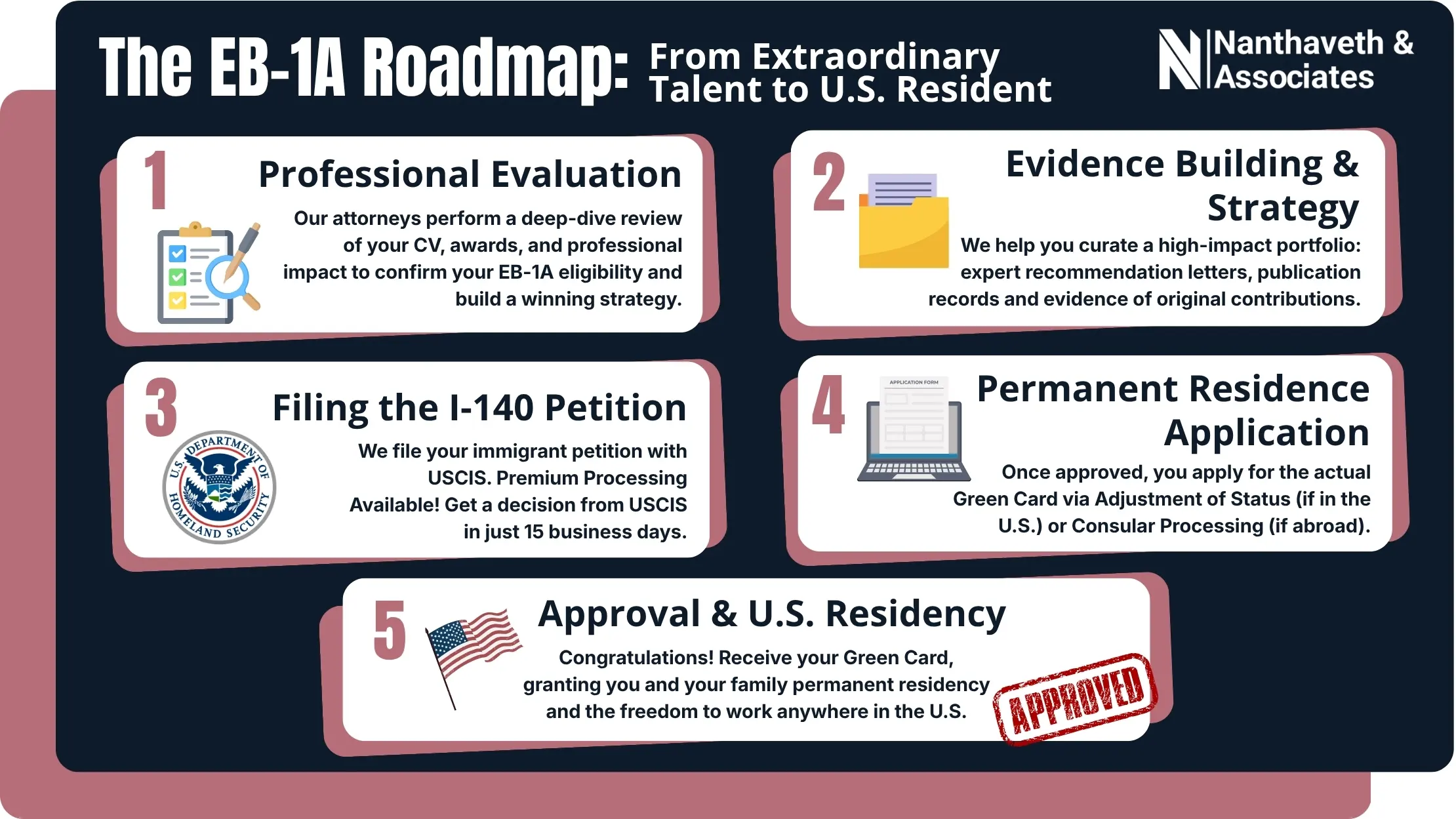
How to Obtain an EB-1A Visa: The Application Process
The path to EB-1A approval begins long before the initial petition is filed. Putting together a compelling case demands careful planning, shrewd evidence selection, and a clear strategy for showcasing extraordinary ability.
The process typically includes the following steps:
- Evidence gathering: Collect things like letters of recommendation, publication records, citation counts, media coverage, award certificates, and organizational documentation.
- Filing Form I-140: In the EB-1A category, you may self-petition by filing your own Form I-140, Immigrant Petition for Alien Worker.
- Premium processing (if appropriate): Some applicants opt for premium processing to receive a faster decision on their I-140 petition.
- Adjustment of status or consular processing: Once you’re eligible to move forward, you’ll apply for permanent residence inside the U.S. or through a consulate abroad.
The right filing strategy depends not only on your evidence but also on your location and time frame, and the availability of visas.
#cta_start
Not Sure If Your Record Meets the Standard?
Many talented professionals have the right background for an EB-1A visa but present it the wrong way. We can review your profile and help identify the best path forward.
#cta_end
Can You File Forms I-140 and I-485 at the Same Time?
In some cases, yes. If you’re physically present in the U.S. and an immigrant visa number is immediately available in the EB-1 category for your country of birth, you may be able to file Form I-140 and Form I-485 concurrently.
Concurrent filing can be a significant strategic advantage because it may also allow you to apply for work authorization and travel permission while your adjustment of status is pending.
If an immigrant visa number is not yet available, you generally must wait until your priority date becomes current before filing the green card application itself.
Because timing can affect both your eligibility and filing strategy, it’s important to evaluate not just the strength of your petition but also when and how to submit it.
EB-1A vs. O-1 vs. EB-1B vs. EB-2 NIW Visa
For many high-achieving professionals, the choice isn’t between an EB-1A visa and nothing. Other immigration categories may match an applicant’s credentials, career stage, and long-term goals more closely:
Is the EB-1A Visa Right for You?
If your record shows real influence, national or international recognition, and a pattern of documented success, the EB-1A visa may offer a direct path to permanent residence. If your reputation is still developing, another category may be more realistic for now.
The primary question is not whether you’re talented but whether your accomplishments can be translated into a petition that satisfies USCIS’s demanding legal standard.
Requests for Evidence, Common Mistakes, and Other Challenges
Even the most qualified individuals face challenges in seeking EB-1A visas. Common mistakes include:
- Quantity over quality: It’s better to submit five high-impact pieces of evidence than 50 weak ones.
- Poor letters of recommendation: Using generic, circular letters rather than detailed endorsements from independent experts.
- Failing to properly define one’s field: If your field is too broad, you may not be at the top. If it’s too narrow, your prominence may seem insignificant.
- Relying on titles instead of proof: A prestigious job title alone isn’t enough if you can’t document what made your role special or critical.
- Assuming that approval is guaranteed: Even if you satisfy three of USCIS’s criteria, officials will still evaluate your full record and profile.
Requests for Evidence, or RFEs, are common for applicants in the EB-1A category, so it’s important to be able to provide further, more demonstrative evidence if asked.
Speak with an Austin EB-1A Lawyer Today
Navigating the EB-1A eligibility criteria takes more than sterling credentials. You need a clear, focused legal strategy. At Nanthaveth & Associates, we help professionals build persuasive EB-1A visa petitions based on awards, publications, leadership, media recognition, and other notable evidence.
Schedule a consultation today to get assistance evaluating your credentials and formulating the most effective strategy for your EB-1A case.
Frequently Asked Questions About EB-1A Visas
What is EB-1A visa status?
EB-1A is a first-preference, employment-based immigrant category for individuals with extraordinary ability in the sciences, arts, education, business, or athletics. It can lead directly to lawful permanent residence.
How many criteria do I need to meet to obtain an EB-1A visa?
Most applicants must satisfy at least three of the 10 regulatory criteria outlined by USCIS unless they have a one-time major internationally recognized award.
Does the EB-1A visa require a job offer?
No. EB-1A allows self-petitioning, so qualified individuals don’t need employer sponsorship. However, they must still show that they intend to continue working in their field in the U.S.
Is there a minimum salary requirement for the EB-1A visa?
No. A high salary is just one of the 10 possible evidentiary criteria and isn’t required in every case.
Can my spouse and children get visas, too?
Yes. If your EB-1A petition is approved and immigrant visas are available, your spouse and unmarried children under 21 may generally apply as derivative beneficiaries.
How much does an EB-1A visa cost?
The total cost will depend on government filing fees, whether premium processing is requested, whether the case proceeds through adjustment of status or consular processing, and whether the applicant works with an immigration attorney.
How long does the EB-1A petitioning process take?
The timeline can vary based on case preparation, USCIS processing times, premium processing, and the availability of immigrant visas.
Can EB-1A be denied even if I meet three criteria?
Yes. Meeting three out of the 10 criteria is only the first step. USCIS can still deny the petition if the overall evidence doesn’t point to extraordinary ability.
Share This Page



Confused by the Criteria? Get the Help You Need.
USCIS’s standards are subjective. What one officer considers "major significance," another may not. Our team knows how to build a narrative that proves your impact in your field.
Do You Qualify for the EB-1A Visa?
You don’t need an employer to sponsor you if you have extraordinary ability. Reach out to Nanthaveth & Associates for a comprehensive evaluation of your credentials.
Schedule a Consultation
Or call us