EB-2 NIW Visa Guide: Requirements, Benefits, and Timeline (2026 Update)
4/20/26
For many highly skilled professionals, the traditional route to a green card, which requires a specific job offer and the lengthy PERM labor certification, can be a major roadblock. The EB-2 National Interest Waiver (NIW) offers a viable alternative, allowing exceptional individuals to self-petition and bypass these hurdles entirely.
At Nanthaveth & Associates, our Austin EB-2 visa lawyers help researchers, entrepreneurs, and experts approach the NIW process to achieve their immigration goals. This guide breaks down the EB-2 NIW requirements, the application process, and changes to expect in 2026.
EB-2 Visa Meaning: What Is the National Interest Waiver?
The EB-2 visa is an employment-based, second-preference visa category. Typically, this category requires a U.S. employer to prove that no qualified U.S. workers are available for a specific role.
The National Interest Waiver is a sub-category that waives the job offer and PERM labor certification requirements because the applicant’s work is deemed so beneficial to the United States that it outweighs the need for labor market testing.
Key Benefits of the EB-2 NIW
The National Interest Waiver offers several strategic advantages, including:
- Self-petitioning: You don’t need a U.S. employer to sponsor you.
- No PERM labor certification: You avoid one of the longest and most restrictive parts of the standard employment-based green card process.
- Career flexibility: You have more freedom to change roles, work across institutions, or pursue your own venture as long as you remain in your proposed endeavor.
- Premium processing for the I-140 stage: In many cases, you can request faster adjudication of the employment petition itself.
- Family immigration benefits: Your spouse and unmarried children under 21 may also qualify for derivative immigration benefits.
For many applicants, the biggest selling points of the EB-2 NIW are control, flexibility, and the chance to validate the national value of their work. Entrepreneurs, researchers, physicians, business consultants, and innovators often benefit from the NIW structure because their work may serve broader national interests beyond a single employer.
#cta_start
Build a Strong Case for National Importance
The national importance aspect is generally where applicants face the most scrutiny. Our team knows how to frame your expertise to meet USCIS’s high standards.
#cta_end
EB-2 vs. EB-2 NIW: What’s the Difference?
This is one of the most common questions our clients ask. A standard EB-2 case usually depends on employer sponsorship, a permanent job offer, and labor certification. An EB-2 NIW case eliminates those requirements if the waiver is granted.
That crucial distinction affords NIW applicants much more flexibility, especially if their work isn’t tied to one employer, one location, or one traditional job description.
EB-2 National Interest Waiver Eligibility
To establish your eligibility for the EB-2 National Interest Waiver, you must first meet the basic EB-2 threshold and then satisfy the three-part NIW test.
Basic EB-2 Requirements
First, you must demonstrate that you’re either a professional with an advanced degree or a person of exceptional ability.
Advanced Degree
You must hold a U.S. master’s degree (or higher) or a foreign equivalent, or a bachelor’s degree plus at least five years of progressive, post-baccalaureate work experience in the field.
Exceptional Ability
You must showcase expertise significantly above what’s ordinarily encountered in your field. This often involves meeting at least three of the listed USCIS criteria, such as extensive experience, a professional license, a high salary, recognition for achievements, or membership in professional associations.
The Three Prongs of the "Matter of Dhanasar"
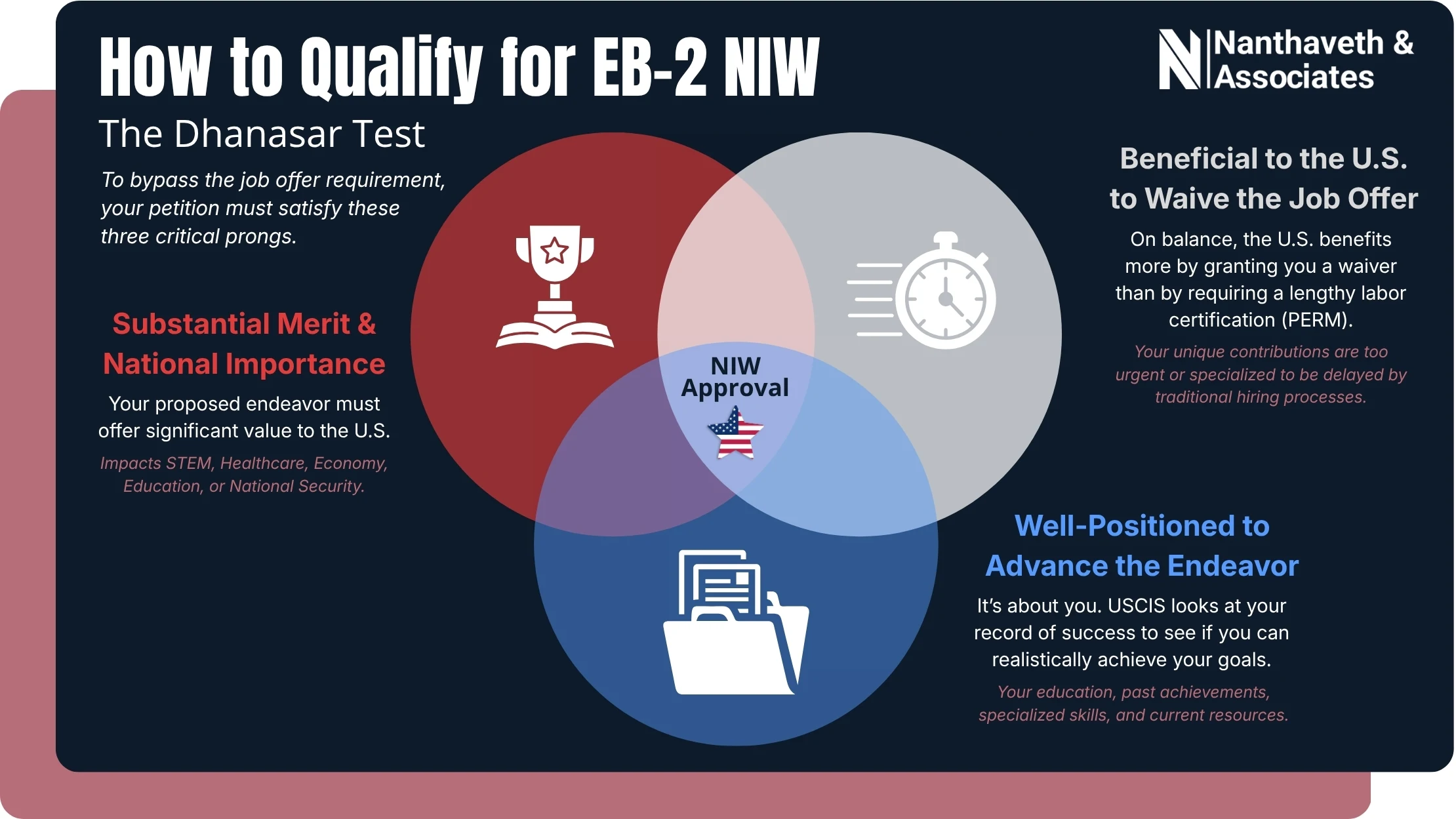
Once you’ve met the basic eligibility requirements, your application must satisfy the three essential criteria established by the Matter of Dhanasar precedent of 2016:
- Substantial merit and national importance: Your proposed endeavor must have considerable value in a field like STEM, healthcare, business, or education.
- Well-positioned to advance the endeavor: USCIS will look at your record (your education, past successes, and current resources) to see if you’re likely to succeed.
- Beneficial to the United States: You must prove that, on balance, the country would benefit more by letting you skip the PERM process than by requiring it.
What Types of Professionals Commonly Qualify?
While NIW cases are often associated with researchers, the category is broader than many applicants realize. Strong candidates may include:
- Scientists and academics
- Engineers and IT professionals
- Physicians and healthcare specialists
- Entrepreneurs and startup founders
- University faculty and postdoctoral scholars
- AI, data science, and cybersecurity professionals
- Public health experts
- Clean energy and infrastructure professionals
- Business leaders whose work has broad economic impact
It isn’t about your job title alone but whether your work can be framed as important to the U.S. and whether the evidence suggests that you’re well-positioned to continue it.
#cta_start
Unsure Whether Your Work Qualifies for EB-2 NIW?
Beyond having impressive credentials, a compelling NIW petition is about showing USCIS why your work matters to the United States and why you’re the right person to advance it. Our skilled team can help you strengthen your profile and develop a strategy around the strongest parts of your case.
#cta_end
The EB-2 NIW Application Process
Applying for the EB-2 NIW visa is a multi-step process that unfolds as follows:
Define the Proposed Endeavor and Build Your Case Strategy
Before filing, it’s critical to clearly define what you plan to do in the U.S. and why that work matters nationally. You must present a focused legal narrative, not just extensive professional credentials.
File Form I-140
This step is the core of the application process. Your petition must show both that you qualify for EB-2 status and that you separately meet the NIW standard.
Submit Supporting Evidence
A persuasive filing may include evidence like:
- A detailed petition letter or legal brief
- Expert recommendation letters
- A résumé or CV
- Academic records and credential evaluations
- Evidence of work experience
- Publications, citations, patents, grants, or awards
- Business plans or project plans for entrepreneurs
- Media coverage, contracts, funding, or proof of measurable impact
If you’re unsure which types of evidence will most benefit your petition, it’s wise to consult a qualified immigration attorney.
Consider Premium Processing
Premium processing may be available for your I-140 petition, allowing USCIS to complete that stage more quickly. However, it’s important to remember that premium processing doesn’t speed up things like the movement of the visa bulletin, adjustment of status, or consular interview scheduling.
Apply for Your Green Card
Once your Form I-140 has been approved and the priority date is current, you may move to the final stage through either adjustment of status (for eligible applicants in the U.S.) or consular processing (for applicants completing the process through a U.S. consulate abroad).
EB-2 Visa Processing Times in 2026
As of early 2026, the EB-2 visa processing time remains a central factor for applicants to consider. Here’s what to know:
- I-140 processing: Standard review can take 12–22 months. However, premium processing is available for a fee and can reduce the review time to 45 business days.
- Visa bulletin backlogs: Depending on your country of birth, you may have to wait for a visa number to become available after your I-140 is approved.
- I-485 processing: Once you file for adjustment of status, expect to wait an additional eight to 18 months to receive your physical permanent resident card.
How Nanthaveth & Associates Can Help
For EB-2 NIW petitions, the difference between an approval and a denial or Request for Evidence often comes down to the quality of presentation. At Nanthaveth & Associates, we don’t just file forms. We build comprehensive cases that highlight our clients’ unique value to the American economy and society at large.
Contact us today to set up an initial strategy session. We proudly serve clients in Austin, throughout Texas, and elsewhere across the globe.
Frequently Asked Questions
Is an EB-2 NIW visa hard to get?
It’s a high-standard category, but it’s reasonably attainable for those with an outstanding professional record. Your success depends on how effectively your legal team links your past achievements to the prospective future benefits for the U.S.
What fields qualify for the National Interest Waiver?
While most applicants are involved in STEM (science, technology, engineering, and math), NIWs are frequently granted in business, healthcare, the arts, and social sciences, provided the specific work being done is promising and has a national scope.
Can I apply for an EB-2 NIW if I’m currently on an H-1B or F-1 visa?
Yes. Many applicants transition from temporary work or student visas to permanent residency via the National Interest Waiver.
Do I need a job offer for an EB-2 NIW visa?
No. One of the main advantages of the NIW is that it waives the normal job offer and PERM labor certification requirements.
Can I self-petition for the EB-2 NIW visa?
Yes. Many applicants file Form I-140 on their own behalf instead of relying on an employer sponsor.
Can entrepreneurs qualify for an EB-2 NIW?
In many cases, yes. Entrepreneurs may qualify if they can show that their venture has substantial merit, national importance, and a realistic chance of positively impacting the United States.
Does premium processing guarantee a faster green card?
No. Premium processing only fast-tracks the review of the I-140 petition. It doesn’t speed up visa availability or the final stage of procuring a green card.
Share This Page



Do You Qualify for a National Interest Waiver?
You can’t afford to guess when it comes to your future. Let our experienced legal team evaluate your profile and determine the best path toward your green card.
Schedule a Consultation
Or call us